


Key takeaways:
- Boot Barn revenue grew 17.9% to $2.254 billion in FY 2026.
- John Hazen, who took over as CEO in 2024, has continued Boot Barn’s aggressive store expansion strategy.
- Boot Barn has also built a sourcing organization, started marketing its exclusive brands as standalone brands and reintegrated the company’s work footwear division into the rest of the business.
Boot Barn’s revenue grew 17.9% to $2.254 billion in fiscal year 2026, driven by the footwear retailer’s 80-store expansion, refreshed marketing strategy and other pillars.
“Over the past year, the team has not only executed on our core strategic initiatives but also exceeded the expectations on the three additional priorities I introduced,” said CEO John Hazen on the company’s earnings call on Thursday.
Those additional priorities include:

- Building a sourcing organization to mitigate the impact of tariffs.;
- Marketing exclusive brands as standalone brands; and
- Reintegrating the footwear company’s workwear division through the rest of the business.
For the fiscal year, which ended March 28, 2026, the Irvine, Calif.-based company reported:
- Consolidated same-store sales growth of 7.2%.
- Retail store same-store sales growth of 6.2%.
- Ecommerce same-store sales growth of 15.3%.
Net income reached $225.9 million, or $7.35 per diluted share, which represented a 25% growth in earnings per diluted share compared to the previous fiscal year.
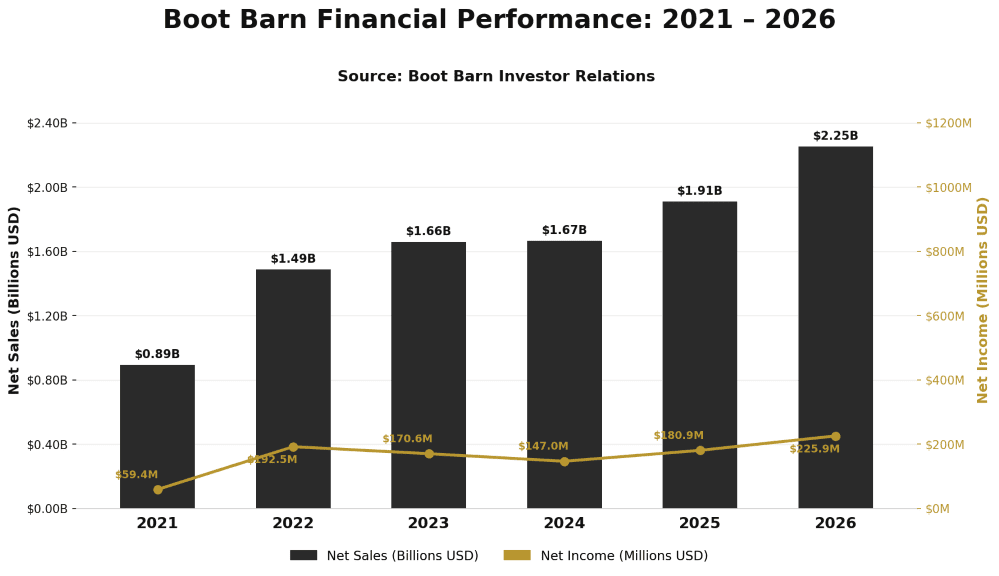
Source: Boot Barn Financial Results. Data verified by Retail TouchPoints, visualized using AI.
Boot Barn has capitalized on a mix of physical footprint expansion and exclusive brand penetration to drive margins. Merchandise margin increased 80 basis points to 50.9%, fueled by buying economies of scale and a deliberate shift toward proprietary product lines.
Boot Barn Expands Store Count with Long-Term Target of 1,200 U.S. Locations
Boot Barn ended the year with 539 locations across the country and has nearly doubled its store count since 2021, when it operated 273 stores. The retailer estimates a long-term target of 1,200 U.S. locations, and plans to open 70 this year, including one on the Las Vegas Strip.
“We often struggle as we think about a new market versus an existing market,” Hazen said. The majority of new stores will be 40+ miles from an existing store, but some located in larger metropolitan markets will be in closer proximity, he said.

Source: Boot Barn FY and Q4 Results. Data verified by Retail TouchPoints, visualized using AI.
The new stores average 12,000 square feet and require a total net investment of approximately $1.7 million each. New locations yield a year-one cash-on-cash return of 53% and a payback period of 1.8 years.
New stores opened within the past five years added approximately 150 basis points to consolidated same-store sales. Mature stores, defined as those opened before March 2021, reached an average unit sales volume of $4.6 million in fiscal 2026.
Navigating Tariffs with New Sourcing Organization
CEO John Hazen was the former Chief Digital Officer and moved into the interim CEO role in 2024; he was appointed CEO on a permanent basis in May 2025. Since taking the helm, he said Boot Barn has made strong progress on its four core strategic initiatives — new store openings, same-store sales growth, omni channel expansion and exclusive brand margin improvement — as well as implementing new initiatives.
Boot Barn also built out its dedicated sourcing organization during fiscal 2026, a move Hazen and CFO Jim Watkins said will begin delivering benefits in late fiscal 2027 and into fiscal 2028.
“This investment proved especially advantageous as the tariff landscape evolved,” Hazen said. “The team’s mitigation efforts and factory negotiations helped drive margin expansion over the past year.”
As Boot Barn enters the next phase of dealing with tariffs, the company is aiming to move more products to Mexico to take advantage of the United States–Mexico–Canada Agreement, Hazen said.
“We’re essentially duty-free,” he said. “We’re also looking at other duty-free countries that are part of other agreements, such as AGOA in the Africa region, and multi-sourcing products that we may have always had in a particular Asian country, and then sourcing it in alternative countries. So it’s always a very fluid situation, but I meet with the sourcing team once a week. We feel great about how they are bobbing and weaving, so to speak, through the tariff environment.”
Marketing Boot Barn’s Exclusive Brands
The company has made notable progress elevating its exclusive brands, launching dedicated websites for Cody James, Hawx Work Gear, Shyanne and Cleo + Wolf, resulting in stronger brand storytelling and increased customer acquisition, Hazen said.
Exclusive brands accounted for 40.8% of total sales, an increase of 220 basis points. The company noted that exclusive brands generate a margin enhancement of approximately 1,000 basis points compared to third-party brands. Boot Barn also engaged consumers and drove brand awareness through its Stagecoach festival sponsorship and other on-site events.
Boot Barn also worked to revitalize its work wear business, achieving four consecutive quarters of accelerating comp sales as in-store merchandising and targeted marketing efforts fueled new momentum in this key category.
Omnichannel Growth and Exclusive Brands
The retailer’s growth extends beyond physical retail; ecommerce same-store sales increased 15.3% for the year.
The company is driving store traffic through ship-to-store options and in-store returns. Boot Barn is also delivering digital experiences through its mobile app and AI-enabled tools, including a pilot program for an in-store consumer AI solution called Cassidy.
Consumer Headwinds and Outlook
Despite the record revenue, the retailer acknowledged macroeconomic challenges. The company noted that its business depends heavily on consumer discretionary spending.
Inflation, changes to U.S. trade policies, and import tariffs could impact future product costs. These factors make estimating near-term business performance more challenging.
Boot Barn expects continued growth in fiscal 2027, projecting total sales to grow between 14% and 16%, to between $2.578 billion and $2.623 billion.
Consolidated same-store sales are expected to grow between 2% and 4%. Boot Barn projects net income per diluted share of $8.21 to $8.64, assuming a 25.7% effective tax rate. Capital expenditures are estimated to be between $125 million and $130 million as the company continues to invest in its expanding store fleet.
“Looking ahead, I believe Boot Barn is well positioned to build on this foundation, and I remain confident in our ability to drive continued growth and deliver long-term value for our shareholders,” Hazen said.